
You’ve got a hardware idea sitting in a your mind, but not sure whats next? I’ve explored countless product ideas with potential clients and a common scenario is they see an opportunity but are unsure what to do next.
While every project is different, thankfully at this early conception stage there is a common starting pattern that can help load you with some data ammo to either defend your idea or shoot it down without investing too much. The key here is to adopt the “fail fast” mentality and try not to get caught up in the excitement of product development too soon.
Understanding what to do first, and where to focus their effort can avoid over investment, save time, and help mature your idea into something real. The reality is, hardware is not easy. Your idea needs to be carefully curatedand battle hardened to navigate the market.
Below is a simple framework I recommend to people exploring hardware ideas:

“You” Problem, or “Others” Problem?
A lot of hardware ideas start with personal frustration. That’s not a bad thing, it’s often where the best ideas come from. The trap is assuming that because you feel the pain, there must be a market for it.
At this point do not jump right in and build the product. Rather, take a moment to work out whether the product is worth building at all. Disattach yourself from your love affair and reframe your thinking from, “This annoys me” to “Are enough other people experiencing this problem”
Ask yourself:
-
Who else has this problem?
-
How often do they experience it?
-
What are they doing today instead of solving it properly?
Assumptions are your nemesis here. Talk to others. Don’t talk abou the solution, rather talk to them about the problem at hand. If they suggest something that you had in mind, thats a huge win. If they suggest something else, note it down as another possible avenue. If you find customers lean away from your perceived angle, assess and pivot if need be.
Right around now clients start to find competitor products, freak out and dump the idea. I can’t emphasis this enough, competitors are a good thing!
Competitors mean:
-
The problem is real
-
Someone has already validated demand
-
There’s an established price range
-
You can learn what works (and what doesn’t)
If this is the case, you’ve just saved a ton of cash and time. You don’t need to invent a new category or demand. You just need a better angle.
The key learning here is if the problem isn’t shared by others, no amount of good design will save it.

Is the Solution Worth the Cost?
Hardware has a reality that software doesn’t… there’s a floor cost and iterative loops are slow. Materials, manufacturing time, assembly, packaging, freight. They all add up quickly. Early on, it’s critical to ask a blunt question:
Can this solution be delivered at a price people will actually accept?
This doesn’t mean you need a perfect costing spreadsheet on day one. It does mean you should sanity check:
-
What this thing roughly costs to make
-
What customers expect to pay for something like it
-
Whether the perceived value comfortably exceeds the cost
A very common failure mode in hardware is building an elegant solution that only works if customers are willing to overpay. That’s not a design problem, it’s a commercial one.
Talking with manufacturing partners early can help inform you of cost early. It wont be 100% accurate, but it will give you a range to work within.
A product that can’t hit a realistic price point at the quantities you need to operate in is a big red flag.

How Will This Actually Reach Customers?
This is where a lot of hardware ideas (including good ones) quietly fall over. People often assume if the product is good, selling it will sort itself out. This is not the case. Its hard to get people to care about your product.
In reality, channel choice shapes the product itself.
Early questions that matter:
-
Is this sold direct-to-consumer, wholesale, or B2B?
-
Online only, or through physical retailers?
-
One-off purchase, or repeatable system?
Each channel comes with constraints:
-
Retail demands margin, packaging, barcodes, compliance
-
DTC demands marketing, fulfilment, returns
-
B2B demands trust, proof, and longer sales cycles
This is where many hardware teams get caught out, they burn the budget on designing the perfect product, but underestimate the work required to convince someone to buy it.

Size it up
This isn’t about talking people out of big ideas. It’s about being honest about what different ideas demand from you. In hardware, ambition and risk scale exponentially, not linearly.
I love the acronym KISS – Keep it simple stupid. Don’t overcomplicate your life if you can avoid it. The moment a product introduces new layers, it often pulls in whole new disciplines and complexities. For example, adding electronics can quickly mean electrical engineering, firmware or app development, compliance, and ongoing support. What looks like a small “nice to have” feature now became a major commitment.
Similarly, products with complex mechanisms often need more than good design intent. They may require mechanical engineering input, tighter tolerances, more precise prototyping, and stricter manufacturing control.
None of this makes those ideas bad, it just makes them bigger bets.
Smaller products in well-understood domains are often a safer place to start:
-
Familiar materials and processes
- Less R&D
-
Known price expectations
-
Fewer specialists required early on
-
Clearer paths to market
Being realistic isn’t about lowering ambition. It’s about choosing an idea that matches your appetite for risk, time, and complexity right now.
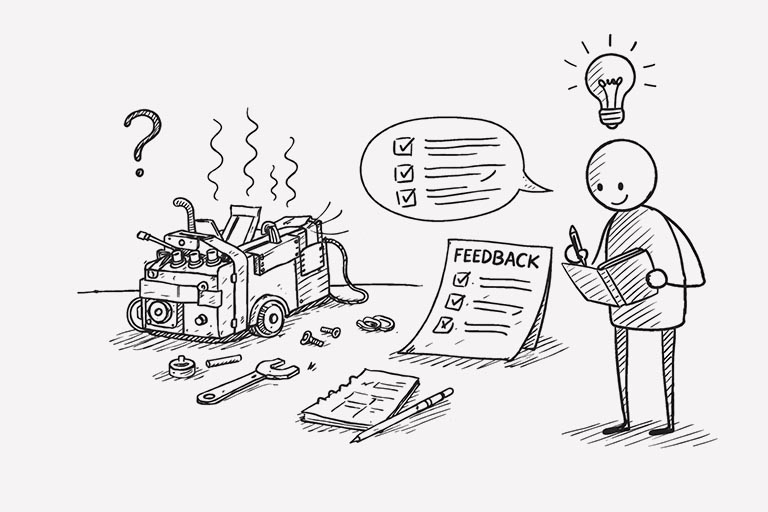
Build to Learn
AI has changed the game. People are completely numb to perfect visuals.
AI renders, polished animations, beautiful decks they all blur together. What actually cuts through, especially in hardware, is something physical. Getting a a “works-like” prototype in place early turns heads and gains momentum.
Early prototypes shouldn’t be:
-
Over-engineered
-
Over-finished
-
“Launch ready”
They should be no-frills, works-like prototypes.
The goal is to:
-
Prove the core function
-
Expose what breaks
-
Learn what matters, and what doesn’t
-
Get real, grounded feedback
A rough physical prototype on a table sparks better conversations than the best-looking render on a screen. It invites critique. People touch it, question it, and tell you what they really think.
Early prototypes are for learning and informing how best to move forward.

Design With Scale in Mind
In most cases, high volume is the goal yet setup cost is the barrier. Walk before you run and design your product to grow into its shoes while iterating and improving. Using this to your advantage, you can design toward mass production, while lessening the barrier to entry.
Helpful questions:
-
Could this be made 10×, then 100×, then 1,000×?
-
What breaks when quantity increases?
-
Which shortcuts are safe now, but dangerous later?
Good hardware products tend to grow up in stages:
-
Low-investment prototypes
-
Small batch builds
-
Refined assemblies
-
Eventually, mass-manufactured systems
The mistake is jumping straight to high-commitment processes before the product has earnt it. Tooling is expensive so lets be sure when the steel is cut.
Final Thoughts
Not every good hardware idea needs to become a startup. Some become side projects. Some become niche businesses. Some are better left as experiments. What matters is being deliberate and not charging ahead blindly hoping for the best.
Just as importantly, knowing when to accept that an idea has failed can be a success in itself. Walking away early is often the smartest (and cheapest) decision you’ll make.
If you’ve got a physical product idea you’ve been sitting on, this framework should help you work out where you are and what your next sensible step actually is. If something feels stuck, it’s usually because one of these was skipped or left too late.
If you want help applying this thinking to your own idea, I’ve built a short, guided process called Idea to Action. It’s designed to help pressure-test hardware ideas, clarify risk, cost, and channels to market, and decide what’s worth pursuing before things get expensive.
